See the pattern before you buy it. The MCP-Server Playbook ships the exact architecture already running at github.com/tounsils/ask-me-mcp, a public MIT-licensed reference implementation. Install it in Claude Desktop or Claude Code and interact with the pattern during our discovery call: six typed tools, a coordinator, rails and confidence scoring, external grounding, an evaluation corpus and a certification gate. Every element of the pattern is visible in the source.
Live endpoint: https://ask-me-mcp-xi.vercel.app/api/mcp
Product 1: MCP-Server Product Playbook
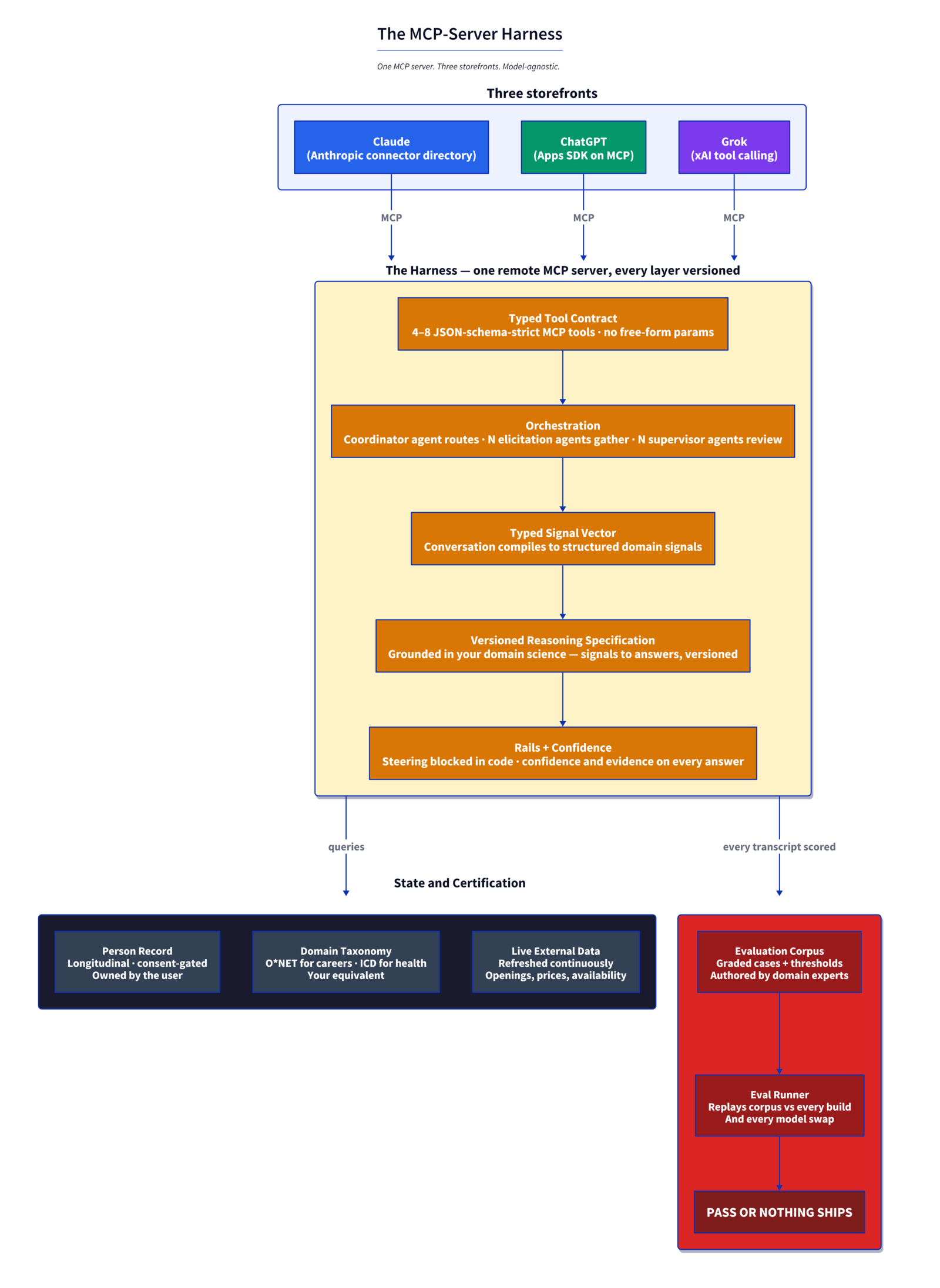
Your product ships as a remote MCP server in Anthropic's connector directory, ChatGPT's Apps SDK, and via xAI's tool-calling API. One MCP server. Three storefronts. Same code.
What you get in 6 weeks
- Typed tool contract. Four to eight JSON-schema-strict MCP tools. No free-form params, no prompt-engineering surface area.
- Coordinator and specialist agent architecture. The coordinator routes, elicitation agents gather, supervisor agents review before the response goes out.
- Signal-extraction pipeline. Every conversation compiles to a typed signal vector. Structured, versioned, inspectable.
- Versioned reasoning specification. Grounded in your domain science, not the model's guesses. Whatever framework governs your field, we ship it as spec.
- Rails and confidence-per-answer discipline. Steering blocked in code. Every response ships with a confidence level and its evidence.
- Grounding architecture. The harness queries your data sources, external APIs, and reference taxonomies. The model never invents.
- Evaluation corpus, eval runner, per-model-pairing certification. You author the corpus with my guidance. I ship the runner and the gate. Pass or nothing ships.
- Remote MCP server deployment. Production endpoint, auth, observability, and the connector-directory listing paperwork.
- One passing eval on your production tool contract by week 6.
Week by week
| Week | Deliverable | Gate |
|---|---|---|
| 1 | Product definition, candidate tool list, input/output schemas, architecture map | You validate the target user flow and the tool contract. No tool contract without schema review. |
| 2 | Grounding sources identified, confidence and refusal policy in code, first versioned reasoning spec | Domain science is explicitly encoded, not left implicit. Critical edge cases documented. |
| 3 | Coordinator routes, specialist workers, handoff behavior, first evaluator pass | Tool routing is inspectable and deterministic. The system can explain which path it used. |
| 4 | Evaluation corpus, eval runner, documented failure cases and known gaps | Every core tool has a smoke eval and a failure case. You confirm behavior matches product intent. |
| 5 | Auth, deployment, observability, production logging, final fallback logic | A deployable remote MCP endpoint exists. Critical failure modes are handled and visible. |
| 6 | End-to-end smoke tests, final eval pass, connector-directory launch checklist, handoff notes | One passing eval on the final production tool contract, or the refund trigger fires. |
Not in scope
- Your domain implementation. That is your product, the tools call it.
- UI beyond a debug console.
- Marketing, growth, or go-to-market. That is what the retainer is for.
- Fundraise deck work.
Refund trigger
- No live tool contract on the target remote MCP setup.
- No working eval runner or validation gate.
- No production-ready grounding architecture.
- No deployable path to the connector directory.
Failure to reach the shipping state by end of week 6 is failed delivery, not a soft "almost shipped."
Who this is for
Pre-seed to Series A founders who have already decided that going deep on one AI-assistant platform beats building yet another web app. You value defensibility from external certification, not just "we use Claude."
Who this is not for
- Teams that want a chatbot with a retrieval tab.
- Teams without a real domain to encode. The harness is only defensible if you have field science underneath.
- Teams that cannot commit an engineer or PM to the sprint. This is not turnkey.
Cap: one active Playbook engagement at a time. When at capacity, waitlist only.
The architecture you are buying
Product 2: Fractional CTO Retainer
For founders who complete the Playbook and want to keep going, or who need the architecture-adult role without the MCP-shipping wedge.
What you get
- Weekly 60-minute strategy call. Architecture, hiring, vendor selection, risk calls. Recorded. Notes shared same day.
- Monthly written architecture review. Three to five pages on a specific system, with concrete recommendations. Not a slide deck.
- Slack on-call for critical decisions. Same-day response Monday to Friday for decisions blocking your team. Not "can you look at this PR."
- Access to the reusable-patterns library. Twelve documented engineering patterns built across the engagements below. Drop them into your codebase, no attribution required.
- First 90 days deliverable. A yes-or-no verdict on your current architecture, a 12-month hiring roadmap, and the three vendor decisions you should make this quarter.
Explicitly not in scope
- Writing production code for you. Different service, different pricing.
- Attending your all-hands or investor updates. Available as a per-session add-on.
- Managing your engineers day to day. You still need a lead engineer or head of engineering.
- Standing in as full-time CTO for a fundraise. Investors will see through it.
Cap: two active retainer clients at a time.
Product 3: AI Prototyping Workshop
Your product managers, operations leads and founders are now expected to prototype without waiting on engineering. Job descriptions say it out loud: go from idea to working demo yourself. Almost nobody teaches it, and the free material teaches enthusiasm rather than judgment.
Three hours, up to eight people, remote or on-site. Everyone builds and ships one working thing.
What you get
- Every attendee ships a working prototype to a public URL. Their own, built by them, running by the end of the session. They type. I do not touch the keyboard. An artifact somebody watched me build is worth nothing to them on Monday.
- The failure playbook. Where these tools are confidently, invisibly wrong, and the exact wording that recovers it. Built from real breakages, not from documentation. This is the part nobody else sells and the only part that transfers.
- The prompt library. How to make it plan before it builds, how to find out what it assumed, and the one question that catches silently wrong output before anyone else sees it.
- A written reference sheet. What every control does, how to read a diff, when to revert instead of arguing. Yours to keep and to circulate internally.
- Two weeks of asynchronous follow-up. Email me when it goes sideways after the session, which it will. That is when the lesson actually lands.
Explicitly not in scope
- Teaching anyone to be an engineer. Three hours does not do that and anybody claiming otherwise is selling something.
- Production software. What gets built is a prototype, deliberately. It exists to make a decision cheaper, not to be deployed to customers.
- Me building your prototype for you. That is the Playbook, and it is a different price.
- Tool licences. Bring your own accounts, and note that the mainstream tools require attendees to be 18 or over.
Cap: eight people. Past that, somebody is watching instead of building, and watching does not work.
This one has its own page, written for the people who attend rather than the people who buy engagements: the AI Prototyping Workshop, including one-to-one and team pricing.
Terms
| Product | Basis | Term | Cap |
|---|---|---|---|
| MCP-Server Product Playbook | Fixed fee, quoted once | 6 weeks | 1 active at a time |
| Fractional CTO Retainer | Monthly, cancel anytime | Month to month | 2 active at a time |
| AI Prototyping Workshop | Fixed fee per workshop | Three hours | 8 attendees |
| Investor or all-hands session | Per session | Add-on | By arrangement |
On price. All three products are fixed and quoted, not hourly and not estimated. I do not publish the numbers, because the right scope is worth establishing before the figure is, and a rate card invites comparison against work that is not the same work. Ask on the first call, or by email, and you get a straight answer in one line with no qualifying dance.
Combined ceiling: one Playbook plus one Retainer, or two Retainers, or two back-to-back Playbooks. Never two concurrent Playbooks. I would rather turn work away than deliver two sprints badly. Workshops sit outside this ceiling, because three hours does not displace an engagement.
The proof: current engagements
NXT Robotics: RobotogoAI operator platform
Senior Software Engineer, fractional, 2025 to present.
Build RobotogoAI, the operator SaaS console and agent layer that turns raw device telemetry (video, GPS, battery, BLE beacons) into actionable ops decisions for physical-security and field-equipment fleets: stadium venues including Snapdragon Stadium and Petco Park, EV-charging networks, drone operators, and a 300+ site parking pilot.
Own five sub-modules across the platform: a React 19 operator console (Vite, Ant Design, Redux Toolkit, Saga), a Laravel 12 / PHP 8.3 API with Passport auth, a Python and AWS SAM per-tenant deployment pipeline, a Node 20 executive cockpit on Lambda with Aurora Serverless v2 and Cognito, and a dual-audience knowledge repository read by both humans and coding agents.
Recent ships: an end-to-end alerts UI with severity taxonomy and deep-linking, an iOS video playback fix, BLE beacon CRUD, a battery-low threshold service, a telemetry retention pipeline, a Cognito SRP auth migration, and an admin team-management route with invite flow.
AIMIA: AI career and AI-literacy assessment
VP of Engineering, advisory, 2025 to present.
Own the entire engineering surface for a career-guidance harness serving students, young professionals, and adult learners. Institutional partners include Irvine Valley College, MIT, Palomar College, and Mission Edge.
Architected a multi-agent stack (six specialized agents plus a supervisor synthesizer), bidirectional voice over WebSocket with a fallback provider, multilingual output in English, Traditional Chinese, and Spanish, application-layer AES-256-GCM field encryption with an HMAC-SHA256 blind index for email dedupe, and a length-bias anti-cheat detector. Currently leading a container-platform migration between two major clouds.
The reusable-patterns library
Twelve patterns worth stealing, built across the engagements above. Retainer clients get access plus a walkthrough on the ones relevant to their stack. Selected examples:
- The Harness pattern. MCP-server product architecture on rented intelligence: typed tools, coordinator, signal vector, versioned reasoning spec, evaluation-corpus certification gate. The same pattern the Playbook delivers.
- Test to Prod diff review for low-code platforms. For anywhere "publish" is a blackbox mutation with no diff and no rollback.
- Dual-audience knowledge repository. Structured frontmatter plus architecture decision records, read by both humans and coding agents.
- AES-256-GCM field encryption with an HMAC blind index. Encrypted PII that still dedupes and indexes.
- Length-bias anti-cheat detector. Retry when the model writes systematically longer correct answers than distractors.
- Live model discovery and smoke-test switcher. Enumerate models at runtime, smoke-test each, swap the default without a deploy.
Full list on request.
How to book
First 30 minutes are free. A fit check, and an honest answer on whether either product actually solves your problem. If neither does, I will say so.